Payroll Compliance Hub
The first step toward a unified reporting experience, giving HR teams a faster and more reliable way to manage W-2 filings with confidence.
View project →

About
Resume
95% fewer schedules and one source of truth
Public sector agencies were managing over 115 disconnected salary schedules due to system limitations. The redesigned model consolidates these into just a few authoritative schedules per agency that scale with real-world complexity.
Lead Product Designer
Project Manager, Dev Lead, QA
12 weeks
Enterprise SaaS for government HR and compensation management

KPI Highlights
60%
$3M+
30%
The Problem
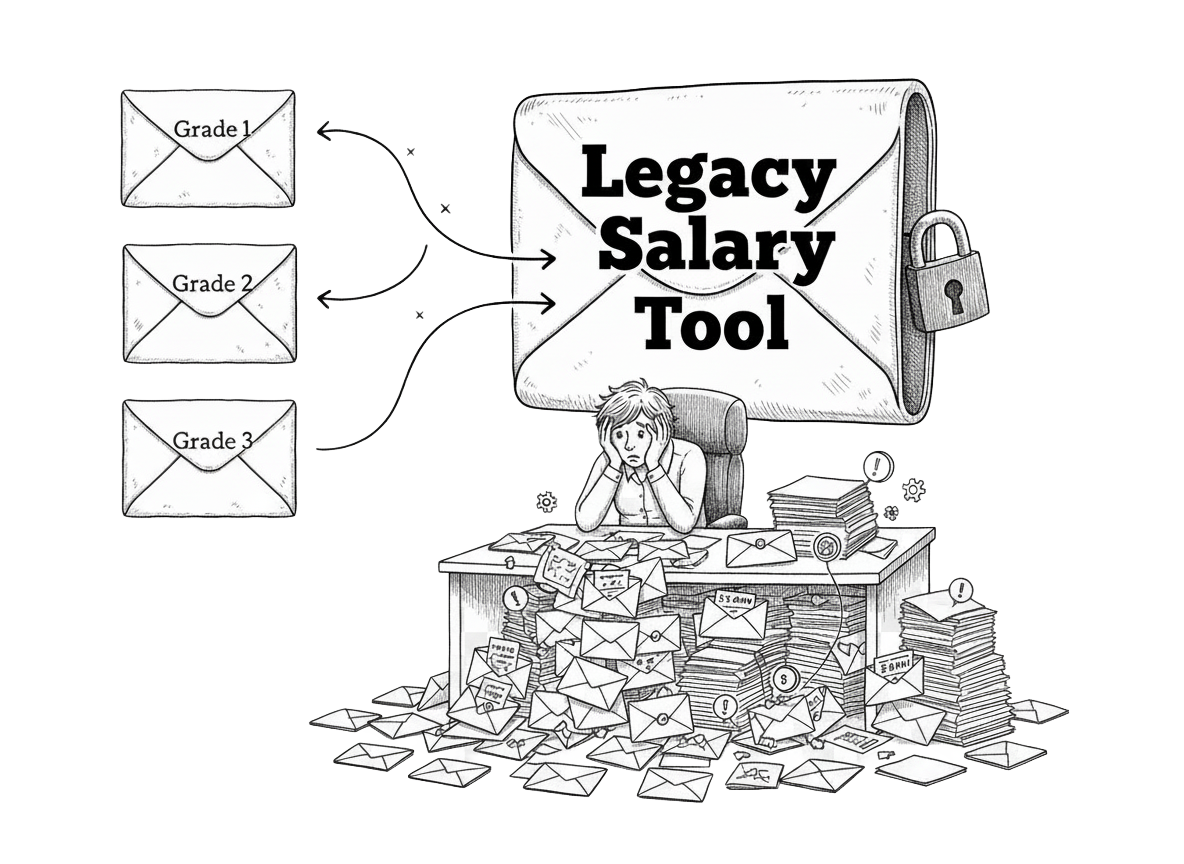
The legacy system only supported a single grade with steps, making it impossible to represent the multi-grade, multi-step structures agencies rely on.

Project Goal
Create a scalable, trustworthy salary schedule system that supports real-world compensation complexity without increasing risk.

Spreadsheet Dependence

Improve Visibility

Enable Confident Change
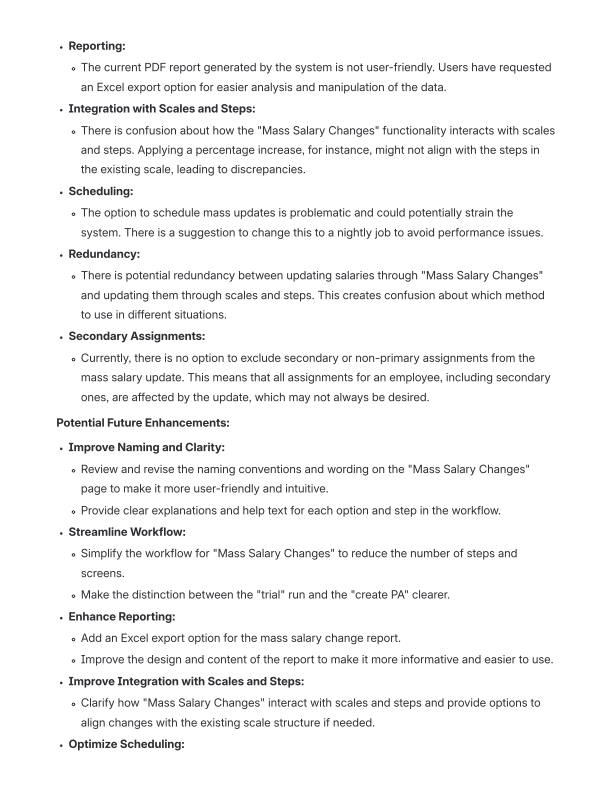
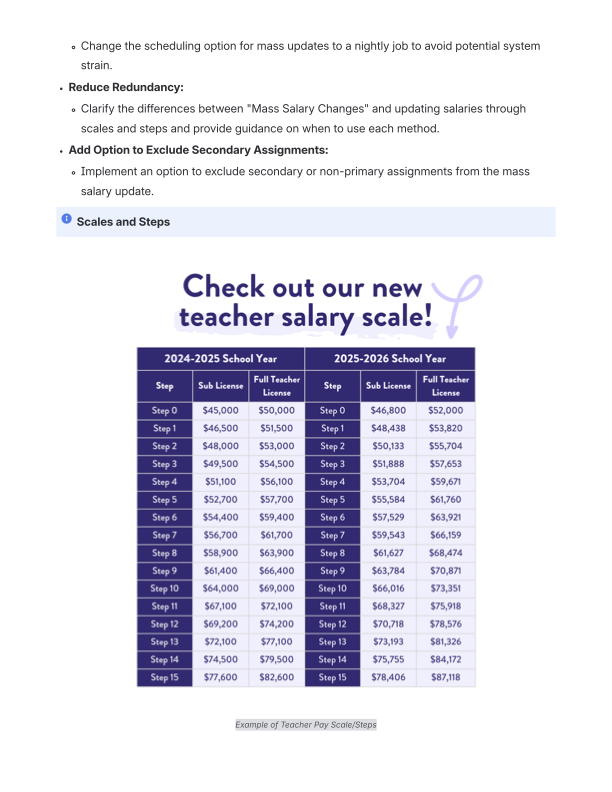
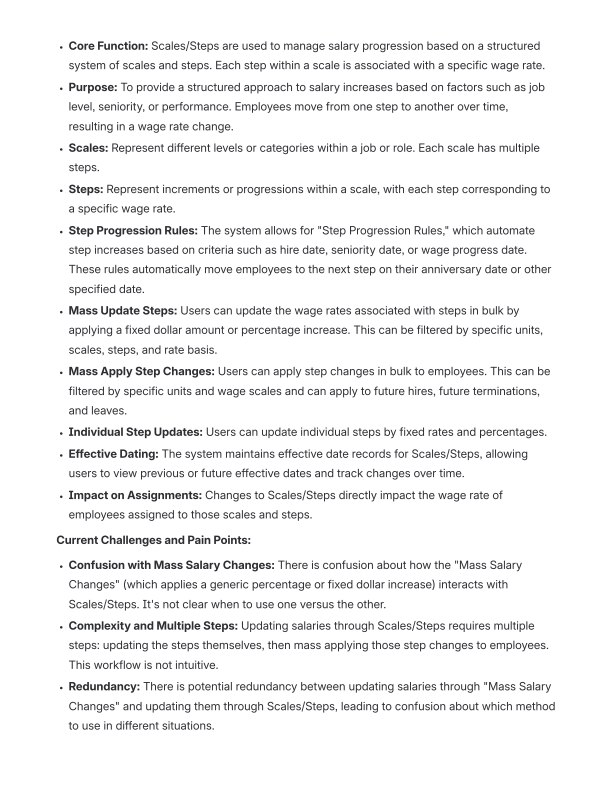
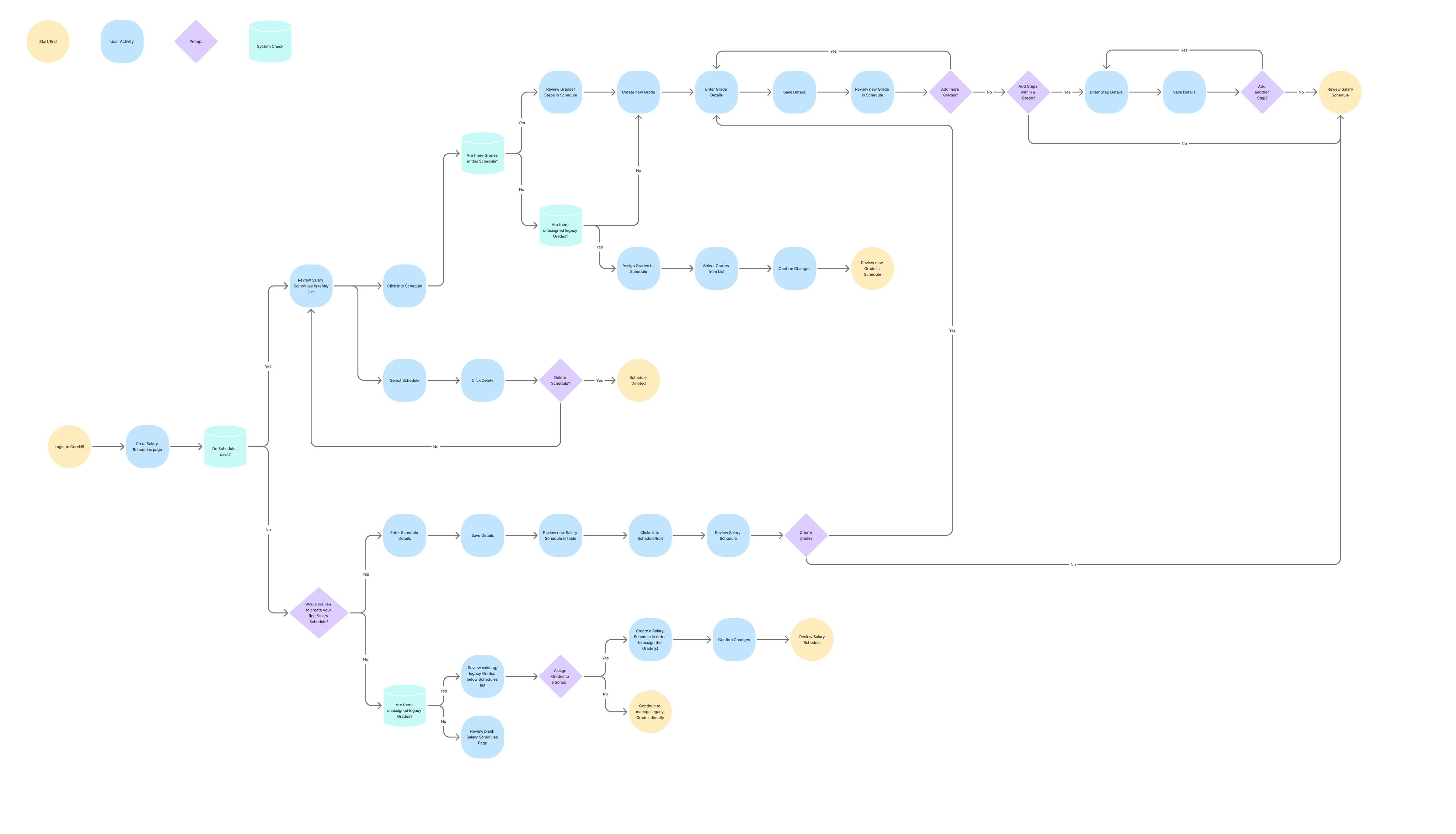
Foundational Learning: Understanding Salary Systems
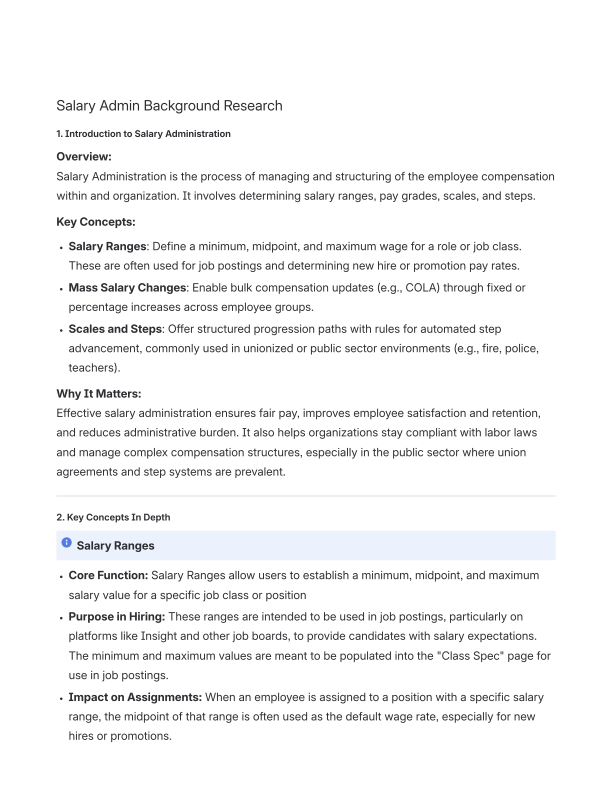
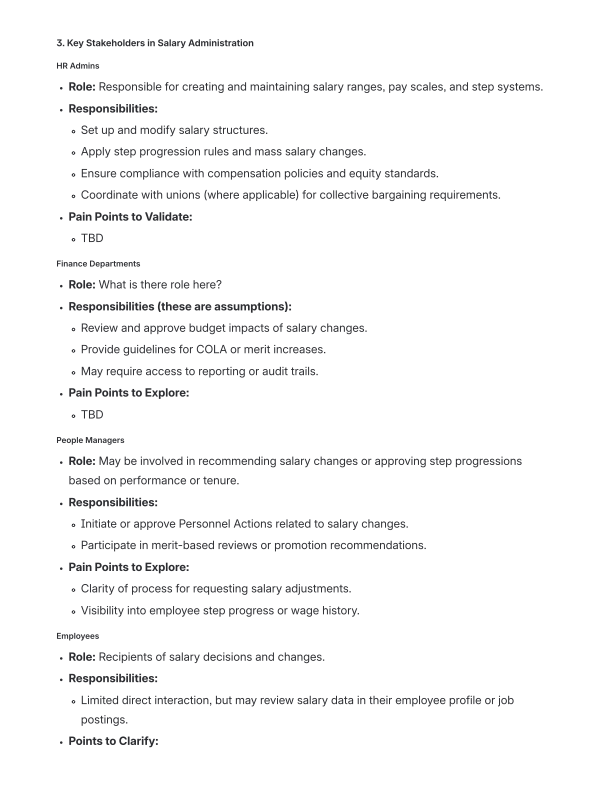
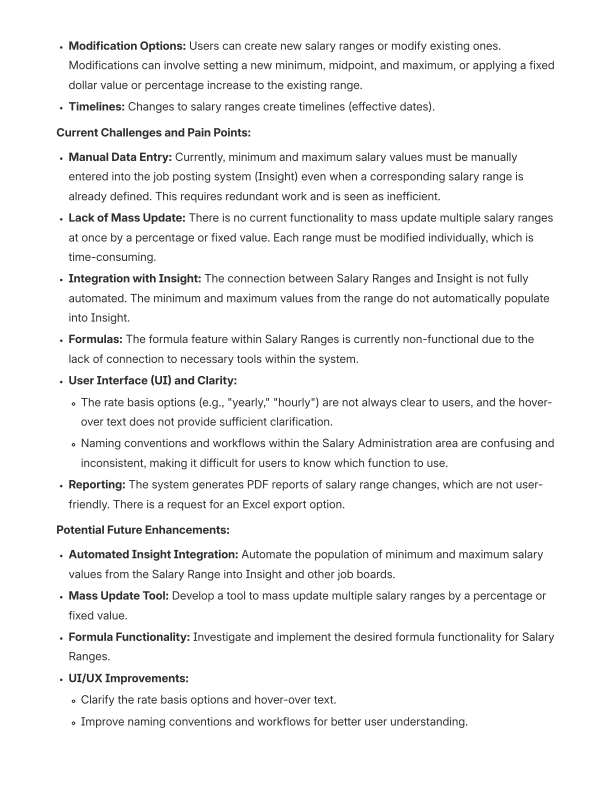
Before speaking with users, I grounded the work by learning how public agencies structure compensation, which helped avoid false assumptions and sharpen discovery.
From Context to Discovery
With the compliance basics in place, I moved into structured discovery to understand how year-end reporting actually works in practice.
(2-week sprint)
Week 1
Weeks 2–4
HR admins experienced with updating salary ranges, managing steps and scales, and handling mass salary changes
What the Research Revealed
Over 10 user interviews (HR admins across multiple agencies) validated the core problems:
Structures are too fragmented and rigid
Marynelle Tana, Sacramento HRA
Bulk updates are slow, manual, and risky
Mandy Dixon, City of Trussville
Timing and effective dating create avoidable stress
Mandie Quigg, City of Athens
Visibility and controls are limited
Chris Wiener, City of Asheville
From Insights to Requirements
We reviewed themes with PM, engineering, and implementation experts to align scope and risk. This collaboration produced a shared problem statement and MoSCoW priorities for the first release.
How might we give HR teams a structured way to manage schedules confidently while reducing the manual steps and uncertainty built into today’s workflows?
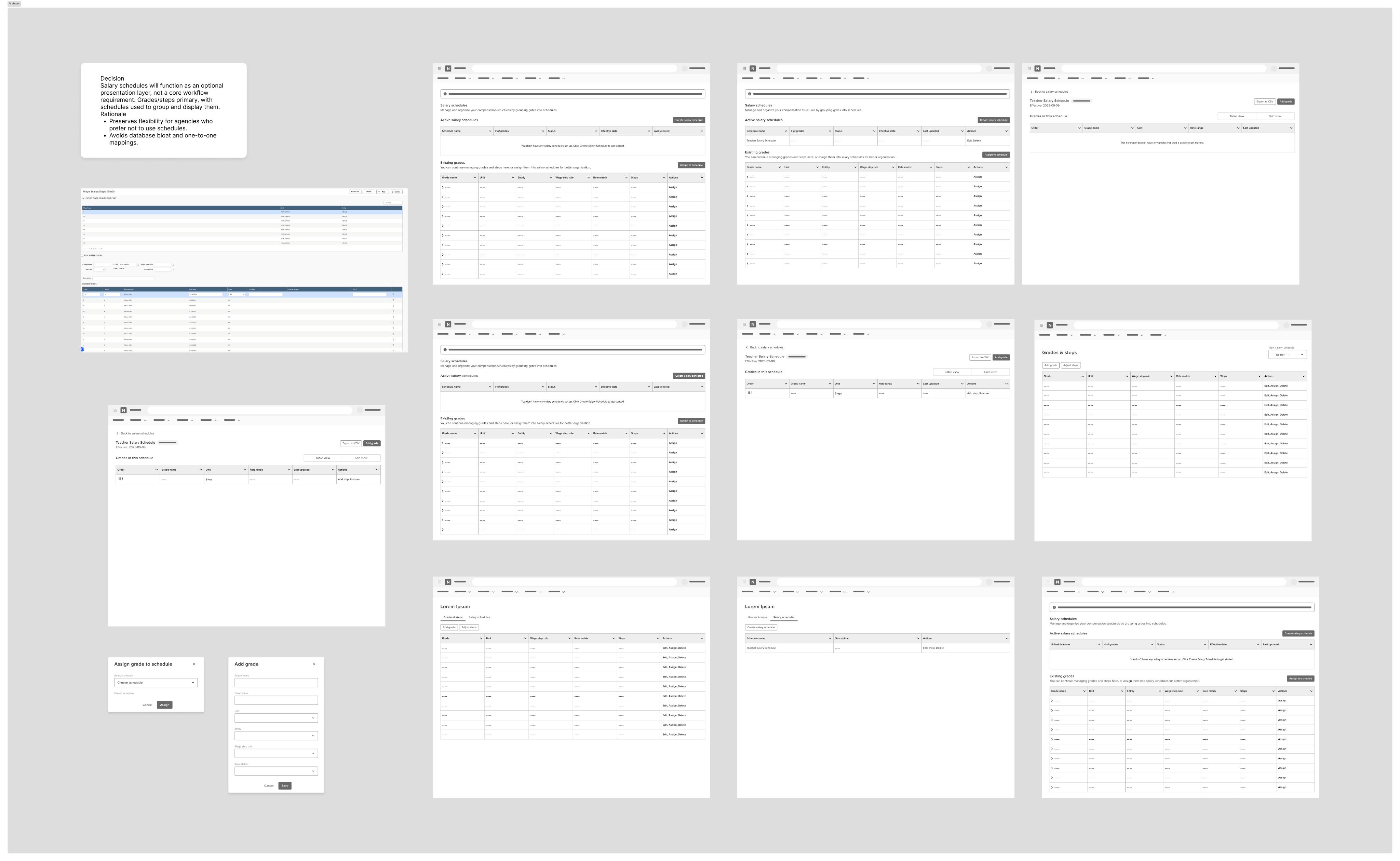
Low Fidelity Exploration
Explored interaction patterns, update logic, and validation states that reduce cognitive load without limiting control.
Weekly feedback cycles surfaced engineering constraints early and accelerated alignment.
Testing with Internal Experts
We reviewed early directions with NEOGOV’s implementation consultants, who work directly with agencies every day. They surfaced where bulk step updates fail in practice, how often COLA adjustments occur, and what safeguards HR teams rely on. This feedback helped refine dependencies, tighten the update flow, and ensure the model reflected real operational needs.

— Payroll Compliance SME
— Implementation Consultant
— Implementation Consultant
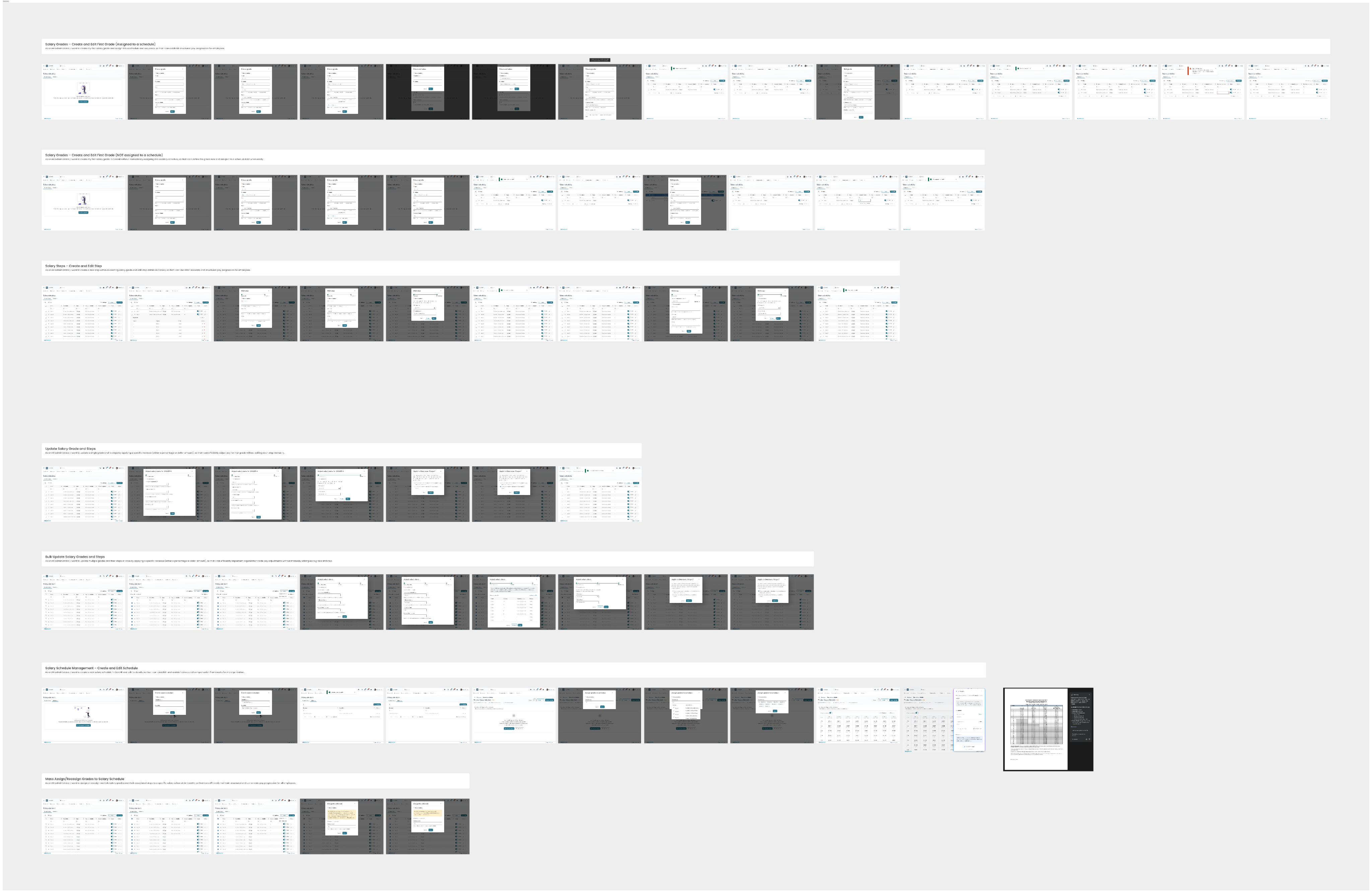
Mid Fidelity Refinement and Visual Direction
As feedback refined the underlying logic, we moved into mid-fidelity to shape how users would actually experience the workflow.
The Final Solution
The new Salary Schedules experience consolidates fragmented compensation structures into a single, scalable model. HR teams can now manage grades, steps, and pay rules in one place with real-time guidance and guardrails.
Before
115+
disconnected schedules per agency

After
4–5
authoritative schedules per agency
Unified Schedule Structure
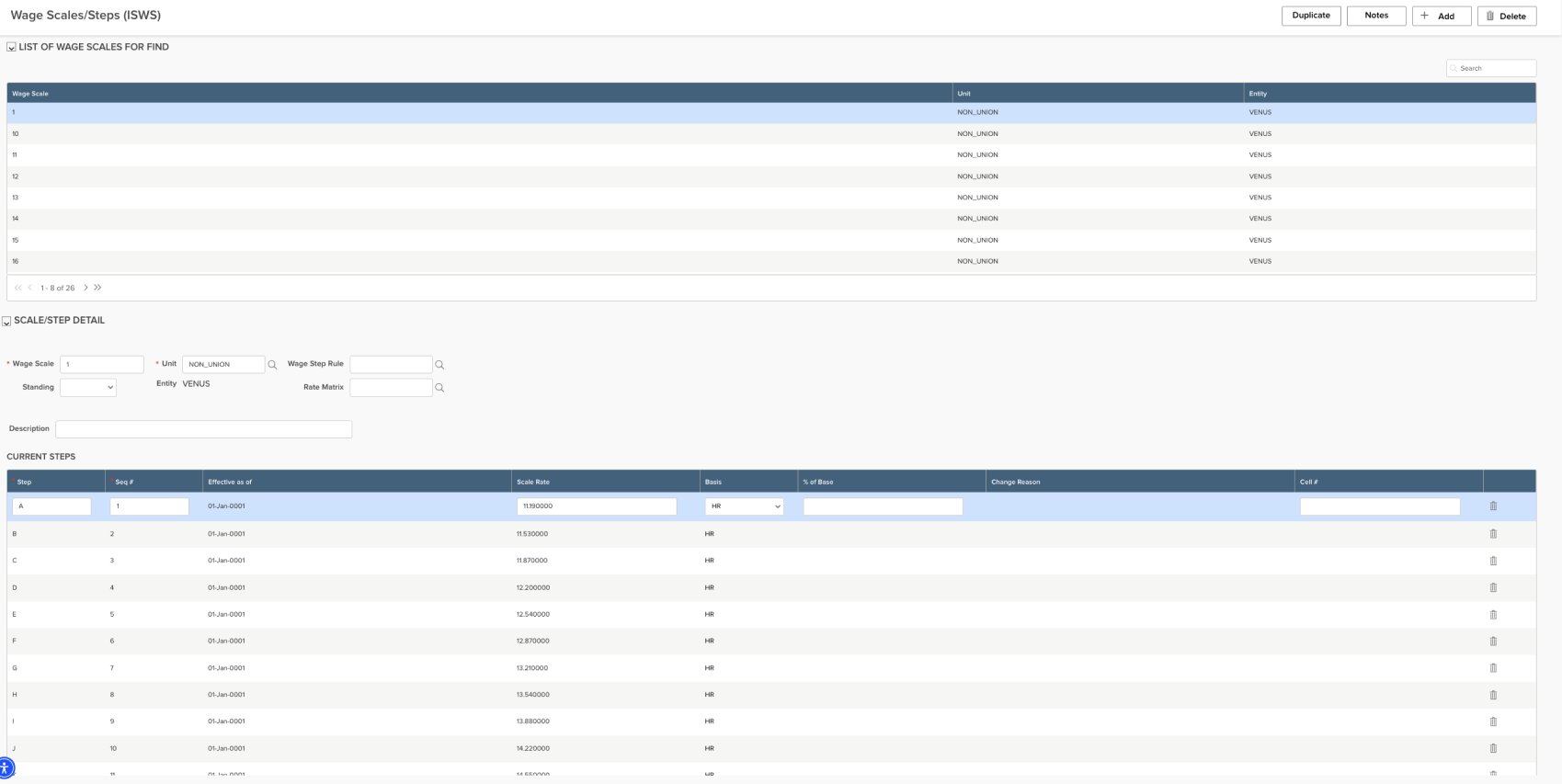
Legacy schedules only supported a single grade with steps, forcing HR teams to duplicate structures and manage alignment offline.
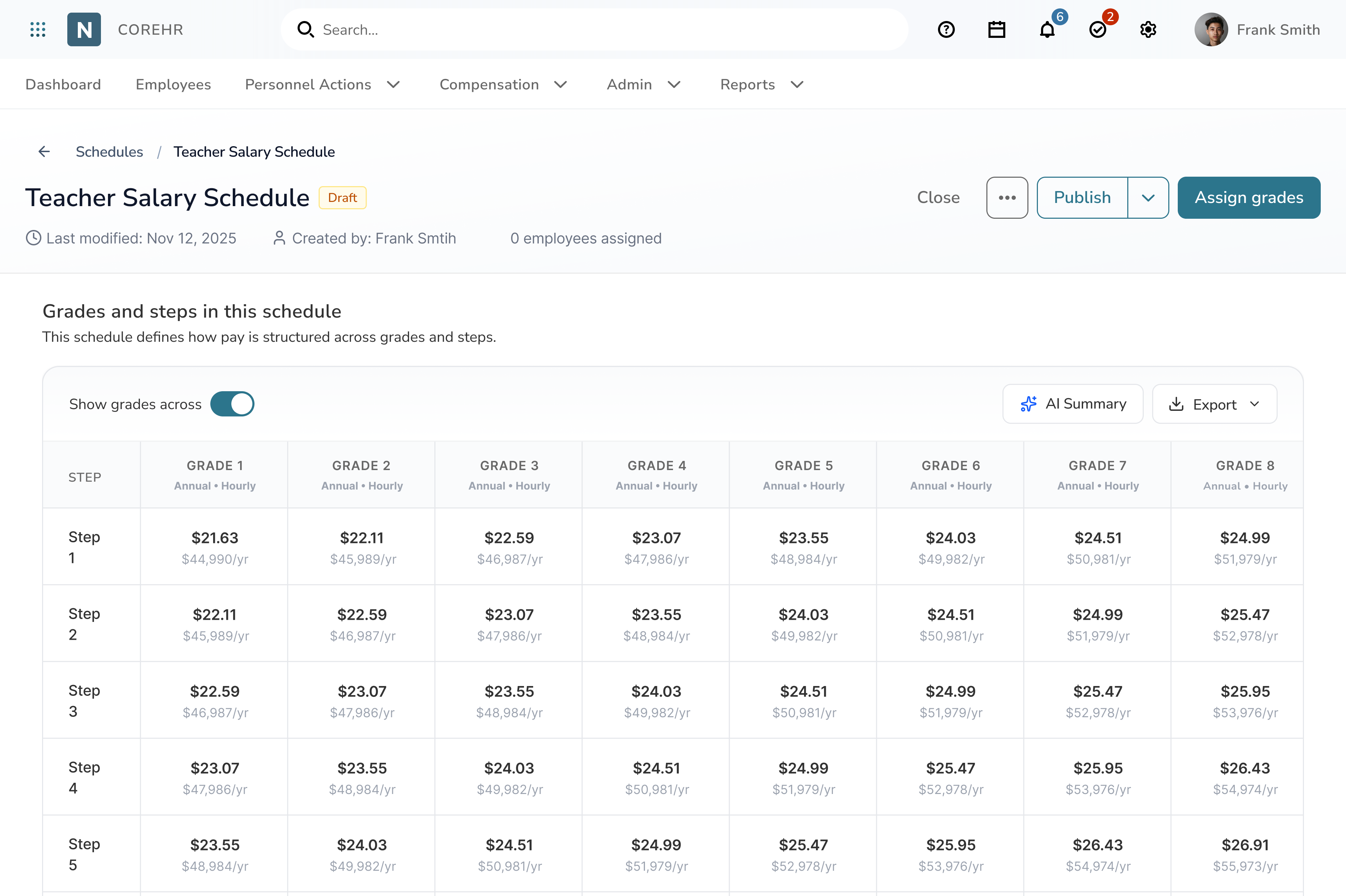
The redesigned matrix model brings grades and steps together in one unified schedule. Clear hierarchy and inline rules eliminate rework and make the entire structure visible at a glance.
Impact: Faster setup, fewer early mistakes, and clearer alignment across pay levels.
Before
After
Creating Grades with Clarity and Control
Building grades used to require spreadsheets and duplicate data entry. Admins lacked confidence that all pay levels were aligned.
The new guided grade builder includes inline rules, structured hierarchy, and a real-time summary table that updates as grades are created.
Impact: Faster schedule creation and fewer early-stage misconfigurations.
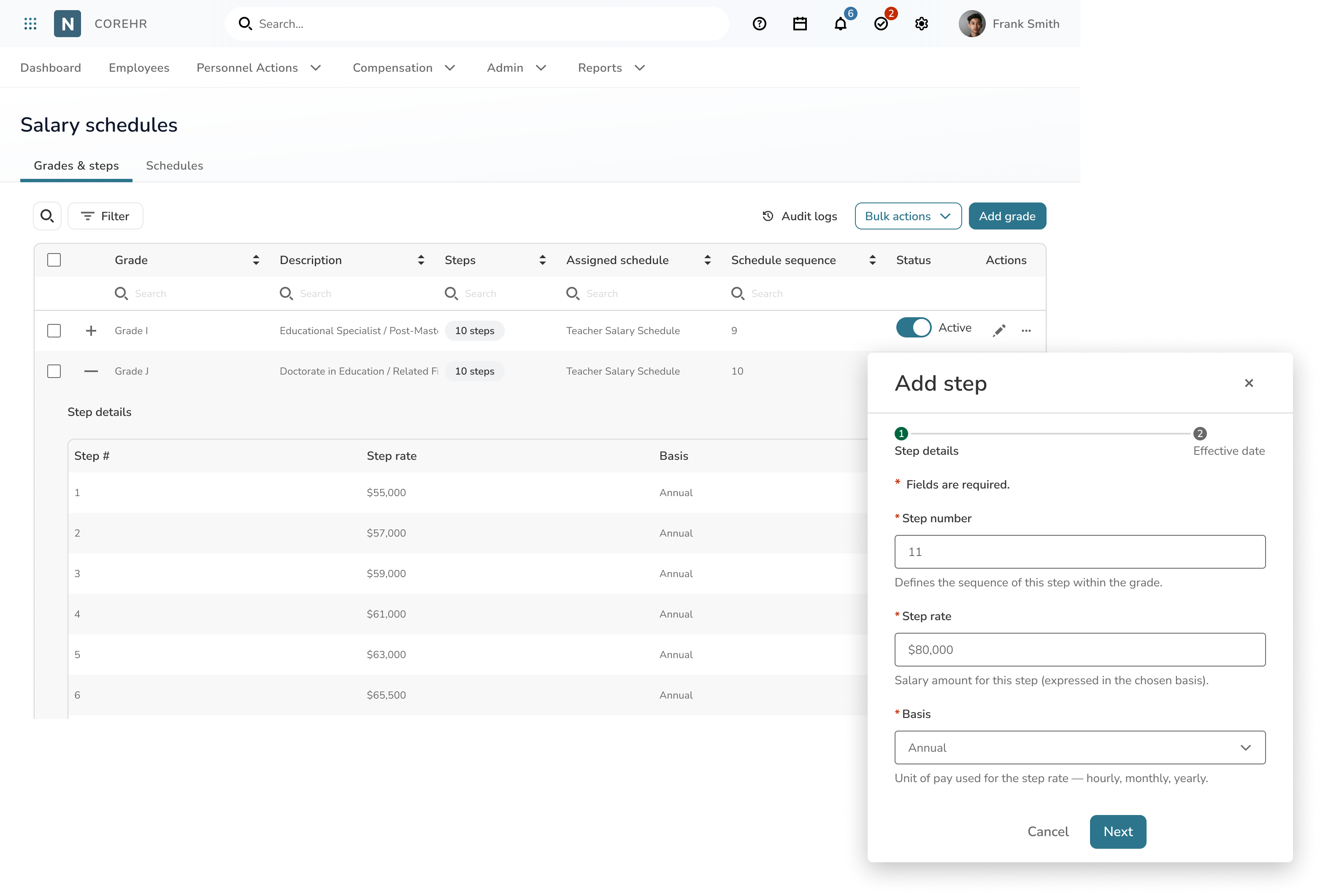
Designing Reliable Step Structures
Step changes in the legacy system risked overwriting history or affecting future pay unintentionally.
The redesigned experience separates step setup from updates and adds effective-date controls, visibility into impacted grades, and safeguards against unintended changes.
Impact: Reduced accidental overrides and fewer step-history errors, with clearer visibility into when and how changes take effect.
Bulk Adjustments with Confidence and Guardrails
Annual COLAs and policy changes often require editing dozens of steps manually, with no preview of impacts.
The new guided update wizard supports percentage or fixed-amount changes, a full preview before publish, and scheduled effective dates for fiscal planning.
Impact: Mass updates are faster and safer. HR teams spend less time on manual checks and more time validating strategic changes.

Neogov AI
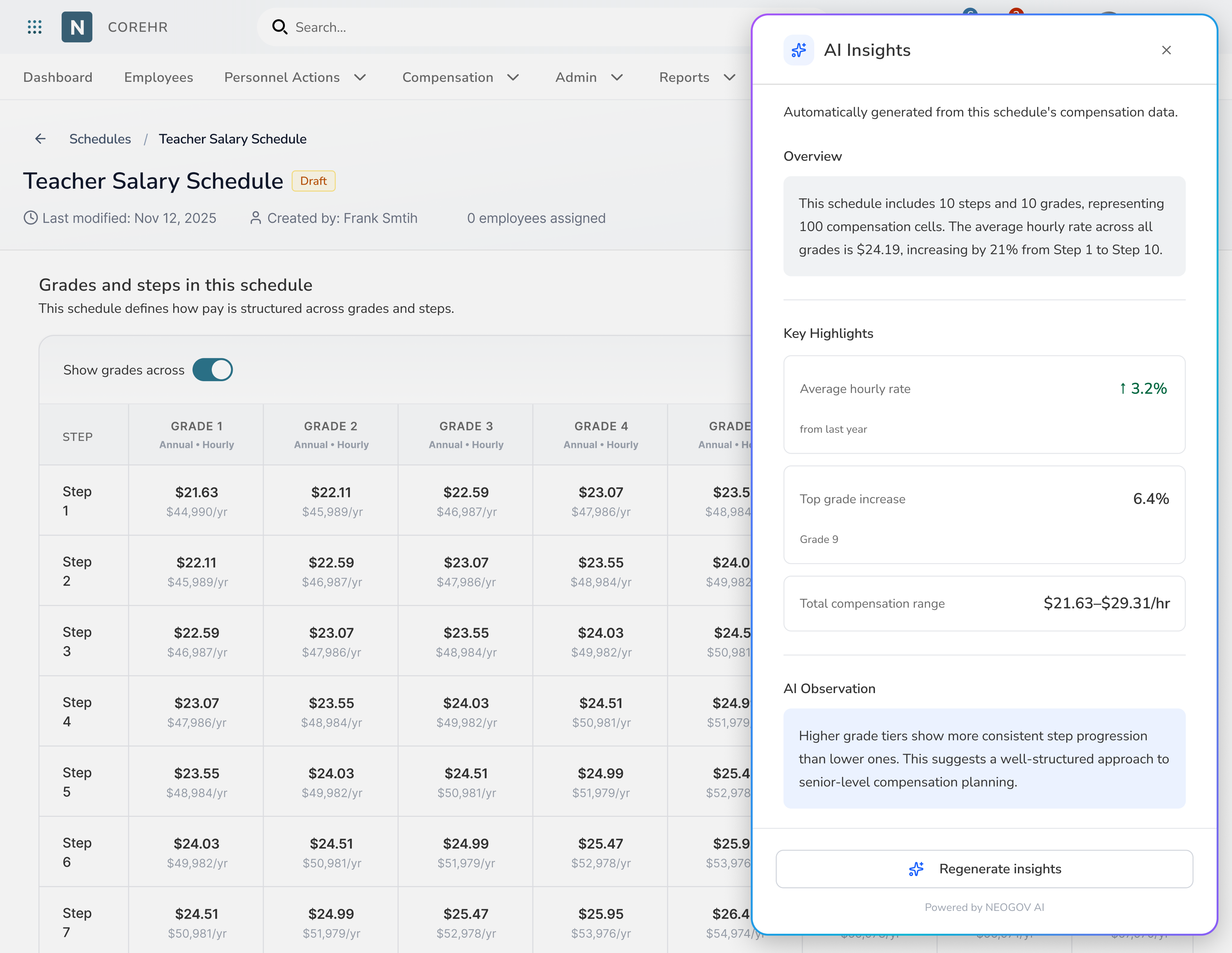
AI-Powered Compensation Insights
Explainable, trust-first summaries designed to help HR teams understand complex salary data at a glance.

Learnings
What this project reinforced about designing complex compensation workflows

Structure builds trust

Discovery reduces downstream risk

Scalable foundations unlock future value
Other Projects 👇
The first step toward a unified reporting experience, giving HR teams a faster and more reliable way to manage W-2 filings with confidence.
View project →
A new import workflow that gives HR teams a clear, guided way to validate and upload historical documents.
View project →
Home
About
Resume
95% fewer schedules and one source of truth
Public sector agencies were managing over 115 disconnected salary schedules due to system limitations. The redesigned model consolidates these into just a few authoritative schedules per agency that scale with real-world complexity.
Lead Product Designer
Project Manager, Dev Lead, QA
12 weeks
Enterprise SaaS for government HR and compensation management
KPI Highlights
60%
$3M+
30%
The Problem
The legacy system only supported a single grade with steps, making it impossible to represent the multi-grade, multi-step structures agencies rely on.
Project Goal
Create a scalable, trustworthy salary schedule system that supports real-world compensation complexity without increasing risk.
Spreadsheet Dependence
Improve Visibility
Enable Confident Change
Foundational Learning: Understanding Salary Systems
Before speaking with users, I grounded the work by learning how public agencies structure compensation, which helped avoid false assumptions and sharpen discovery.
From Context to Discovery
With the compliance basics in place, I moved into structured discovery to understand how year-end reporting actually works in practice.
(2-week sprint)
Week 1
Weeks 2–4
HR admins experienced with updating salary ranges, managing steps and scales, and handling mass salary changes
What the Research Revealed
Over 10 user interviews (HR admins across multiple agencies) validated the core problems:
Structures are too fragmented and rigid
Marynelle Tana, Sacramento HRA
Bulk updates are slow, manual, and risky
Mandy Dixon, City of Trussville
Timing and effective dating create avoidable stress
Mandie Quigg, City of Athens
Visibility and controls are limited
Chris Wiener, City of Asheville
From Insights to Requirements
We reviewed themes with PM, engineering, and implementation experts to align scope and risk. This collaboration produced a shared problem statement and MoSCoW priorities for the first release.
How might we give HR teams a structured way to manage schedules confidently while reducing the manual steps and uncertainty built into today’s workflows?
Low Fidelity Exploration
Explored interaction patterns, update logic, and validation states that reduce cognitive load without limiting control.
Weekly feedback cycles surfaced engineering constraints early and accelerated alignment.
Testing with Internal Experts
We reviewed early directions with NEOGOV’s implementation consultants, who work directly with agencies every day. They surfaced where bulk step updates fail in practice, how often COLA adjustments occur, and what safeguards HR teams rely on. This feedback helped refine dependencies, tighten the update flow, and ensure the model reflected real operational needs.

— Payroll Compliance SME
— Implementation Consultant
— Implementation Consultant
Mid Fidelity Refinement and Visual Direction
As feedback refined the underlying logic, we moved into mid-fidelity to shape how users would actually experience the workflow.
The Final Solution
The new Salary Schedules experience consolidates fragmented compensation structures into a single, scalable model. HR teams can now manage grades, steps, and pay rules in one place with real-time guidance and guardrails.
Before
115+
disconnected schedules per agency
After
4–5
authoritative schedules per agency
Unified Schedule Structure
Legacy schedules only supported a single grade with steps, forcing HR teams to duplicate structures and manage alignment offline.
The redesigned matrix model brings grades and steps together in one unified schedule. Clear hierarchy and inline rules eliminate rework and make the entire structure visible at a glance.
Impact: Faster setup, fewer early mistakes, and clearer alignment across pay levels.
Before
After
Creating Grades with Clarity and Control
Building grades used to require spreadsheets and duplicate data entry. Admins lacked confidence that all pay levels were aligned.
The new guided grade builder includes inline rules, structured hierarchy, and a real-time summary table that updates as grades are created.
Impact: Faster schedule creation and fewer early-stage misconfigurations.
Designing Reliable Step Structures
Step changes in the legacy system risked overwriting history or affecting future pay unintentionally.
The redesigned experience separates step setup from updates and adds effective-date controls, visibility into impacted grades, and safeguards against unintended changes.
Impact: Reduced accidental overrides and fewer step-history errors, with clearer visibility into when and how changes take effect.
Bulk Adjustments with Confidence and Guardrails
Annual COLAs and policy changes often require editing dozens of steps manually, with no preview of impacts.
The new guided update wizard supports percentage or fixed-amount changes, a full preview before publish, and scheduled effective dates for fiscal planning.
Impact: Mass updates are faster and safer. HR teams spend less time on manual checks and more time validating strategic changes.
Neogov AI
AI-Powered Compensation Insights
Explainable, trust-first summaries designed to help HR teams understand complex salary data at a glance.

Learnings
What this project reinforced about designing complex compensation workflows
Structure builds trust
Discovery reduces downstream risk
Scalable foundations unlock future value
Other Projects 👇
The first step toward a unified reporting experience, giving HR teams a faster and more reliable way to manage W-2 filings with confidence.
View project →
A new import workflow that gives HR teams a clear, guided way to validate and upload historical documents.
View project →
Home
About
Resume
95% fewer schedules and one source of truth
Public sector agencies were managing over 115 disconnected salary schedules due to system limitations. The redesigned model consolidates these into just a few authoritative schedules per agency that scale with real-world complexity.
Lead Product Designer
Project Manager, Dev Lead, QA
12 weeks
Enterprise SaaS for government HR and compensation management
KPI Highlights
60%
$3M+
30%
The Problem
The legacy system only supported a single grade with steps, making it impossible to represent the multi-grade, multi-step structures agencies rely on.
Project Goal
Create a scalable, trustworthy salary schedule system that supports real-world compensation complexity without increasing risk.
Spreadsheet Dependence
Improve Visibility

Enable Confident Change
Foundational Learning: Understanding Salary Systems
Before speaking with users, I grounded the work by learning how public agencies structure compensation, which helped avoid false assumptions and sharpen discovery.
From Context to Discovery
With the compliance basics in place, I moved into structured discovery to understand how year-end reporting actually works in practice.
(2-week sprint)
Week 1
Weeks 2–4
HR admins experienced with updating salary ranges, managing steps and scales, and handling mass salary changes
What the Research Revealed
Over 10 user interviews (HR admins across multiple agencies) validated the core problems:
Structures are too fragmented and rigid
Marynelle Tana, Sacramento HRA
Bulk updates are slow, manual, and risky
Mandy Dixon, City of Trussville
Timing and effective dating create avoidable stress
Mandie Quigg, City of Athens
Visibility and controls are limited
Chris Wiener, City of Asheville
From Insights to Requirements
We reviewed themes with PM, engineering, and implementation experts to align scope and risk. This collaboration produced a shared problem statement and MoSCoW priorities for the first release.
How might we give HR teams a structured way to manage schedules confidently while reducing the manual steps and uncertainty built into today’s workflows?
Low Fidelity Exploration
Explored interaction patterns, update logic, and validation states that reduce cognitive load without limiting control.
Weekly feedback cycles surfaced engineering constraints early and accelerated alignment.
Testing with Internal Experts
We reviewed early directions with NEOGOV’s implementation consultants, who work directly with agencies every day. They surfaced where bulk step updates fail in practice, how often COLA adjustments occur, and what safeguards HR teams rely on. This feedback helped refine dependencies, tighten the update flow, and ensure the model reflected real operational needs.
— Payroll Compliance SME
— Implementation Consultant
— Implementation Consultant
Mid Fidelity Refinement and Visual Direction
As feedback refined the underlying logic, we moved into mid-fidelity to shape how users would actually experience the workflow.
The Final Solution
The new Salary Schedules experience consolidates fragmented compensation structures into a single, scalable model. HR teams can now manage grades, steps, and pay rules in one place with real-time guidance and guardrails.
Before
115+
disconnected schedules per agency
After
4–5
authoritative schedules per agency
Unified Schedule Structure
Legacy schedules only supported a single grade with steps, forcing HR teams to duplicate structures and manage alignment offline.
The redesigned matrix model brings grades and steps together in one unified schedule. Clear hierarchy and inline rules eliminate rework and make the entire structure visible at a glance.
Impact: Faster setup, fewer early mistakes, and clearer alignment across pay levels.
Before
After
Creating Grades with Clarity and Control
Building grades used to require spreadsheets and duplicate data entry. Admins lacked confidence that all pay levels were aligned.
The new guided grade builder includes inline rules, structured hierarchy, and a real-time summary table that updates as grades are created.
Impact: Faster schedule creation and fewer early-stage misconfigurations.
Designing Reliable Step Structures
Step changes in the legacy system risked overwriting history or affecting future pay unintentionally.
The redesigned experience separates step setup from updates and adds effective-date controls, visibility into impacted grades, and safeguards against unintended changes.
Impact: Reduced accidental overrides and fewer step-history errors, with clearer visibility into when and how changes take effect.
Bulk Adjustments with Confidence and Guardrails
Annual COLAs and policy changes often require editing dozens of steps manually, with no preview of impacts.
The new guided update wizard supports percentage or fixed-amount changes, a full preview before publish, and scheduled effective dates for fiscal planning.
Impact: Mass updates are faster and safer. HR teams spend less time on manual checks and more time validating strategic changes.
Neogov AI
AI-Powered Compensation Insights
Explainable, trust-first summaries designed to help HR teams understand complex salary data at a glance.
Learnings
What this project reinforced about designing complex compensation workflows
Structure builds trust
Discovery reduces downstream risk
Scalable foundations unlock future value
Other Projects 👇
The first step toward a unified reporting experience, giving HR teams a faster and more reliable way to manage W-2 filings with confidence.
View project →
A new import workflow that gives HR teams a clear, guided way to validate and upload historical documents.
View project →